PRODUCTION & PAGINATION
Deadline night should be boring.
PageScout builds your pages inside InDesign from the ads you actually sold — placed, sized, and on the right page — so production stops rebuilding the paper by hand every week.
THE PROBLEM
One person holds the whole process in their head.
At most papers, one person holds the entire production process in their head. They know which ads are sold, which ones moved, which page the insert goes on, and which advertiser has a contract that says never opposite the obituaries. That knowledge is not written down anywhere, and the paper genuinely cannot go to press without them.
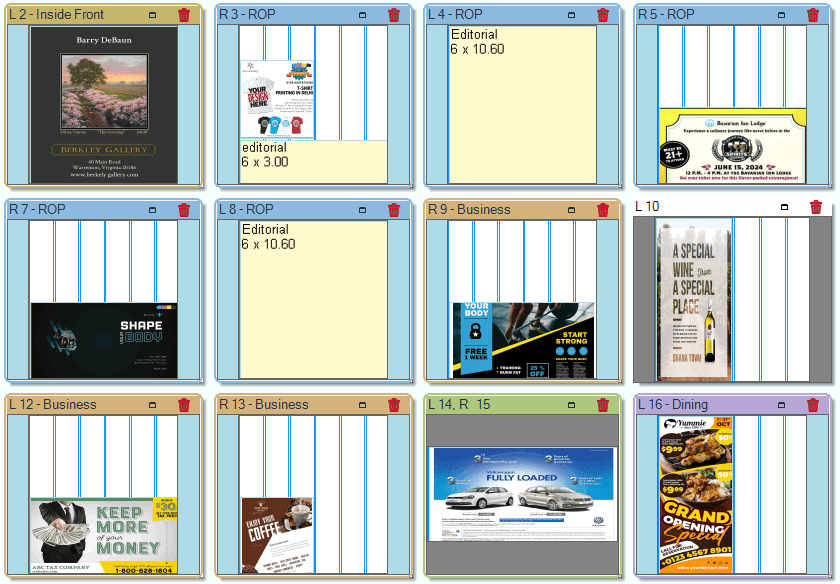
The work itself is manual in a way that has not changed in twenty years. Someone reads a dummy sheet, opens InDesign, and places ads one at a time. When an ad changes size on Thursday afternoon, the pages get rebuilt. When a section grows by four pages, everything shifts and gets rebuilt again.
It is not that people are slow. It is that they are doing by hand something the computer already has all the information to do.
THE PAGE PLAN
The issue, built from the ads you actually sold.
Every booked ad on the real issue date, positioned on a page, with what is still unplaced and what is missing copy counted at the top. It is the dummy sheet, except the computer already had the information.
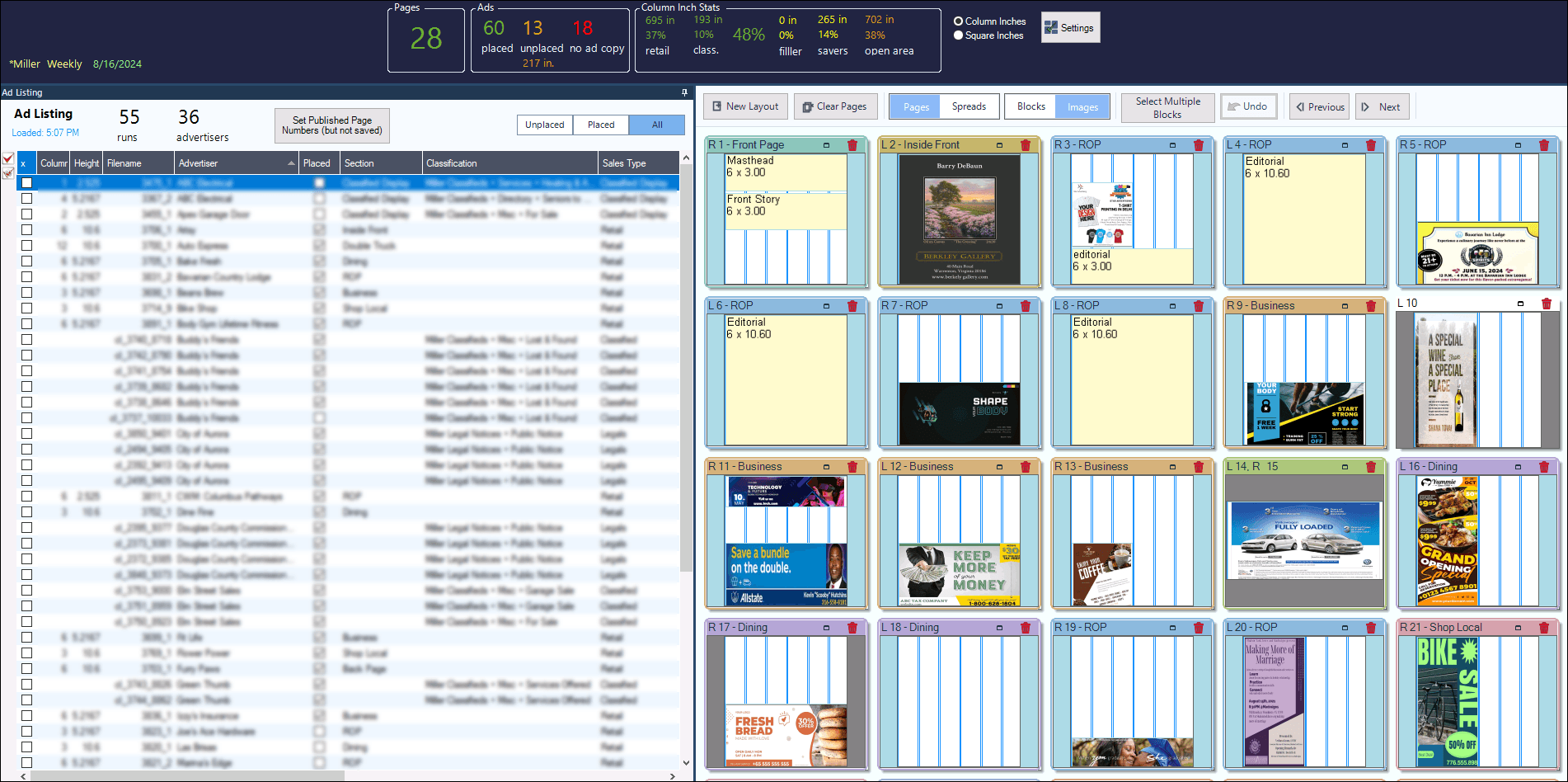
- Placed, unplaced, and no-copy counts beside column-inch statistics for the issue
- Ads listed by advertiser, section, and classification, straight off the orders
- Page thumbnails showing where each booked ad has landed
WHAT CHANGES
The paper builds from what you sold.
- Pages build from the real ad orders, on the real issue dates
- Ad placement rules and advertiser positioning requests are applied automatically
- A late change reflows the page instead of restarting it
- Production status is visible — what is placed, what is missing, what is late
- The process survives the person who currently holds it in their head
HOW IT WORKS
From sold orders to page-ready, inside InDesign.
Your team keeps the application they know. PageScout does the placement work that was being done by hand.
- 1
The orders are already there
Everything sold through AccountScout has a size, a section, an issue date, and any positioning instructions attached. Pagination reads the same records billing will invoice from.
- 2
PageScout builds inside InDesign
Your team keeps working in the application they know, on CS6 and later. PageScout does the placement — it is not a separate layout program to learn.
- 3
Rules get applied without being remembered
Positioning requests, competitive separation, and section rules travel with the order rather than living in one person's memory.
- 4
Late changes reflow
An ad that grows, shrinks, or cancels on deadline day updates the page instead of triggering a manual rebuild of everything after it.
- 5
Status is on the board
Production and editorial can both see which pages are ready and which are waiting, so the deadline conversation is about facts rather than guesses.
PROOF
A weekly paper cut a single issue from nine hours to five and a half — about 182 hours a year, and enough overtime eliminated to matter on the P&L. On issues with sixty or more ad pages, ad placement runs roughly three times faster.
"Mid-Atlantic Media uses Fake Brains' AccountScout for its portfolio of publications. We were effectively able to consolidate our sales, layout, receivables and CRM functions into AccountScout affordably. It's a big deal considering we're running more than a dozen publication titles and over 50 employees through it."
The hours are from the published PageScout case study. That publication asked to stay anonymous.
- 9 → 5.5 hrs
- A single issue's ad and page work, before and after.
- 182 hrs
- Returned to the production department across a year.
- ~3×
- Faster ad placement on issues with sixty or more ad pages.
WHERE IT CONNECTS
Pagination is downstream of everything.
COMMON QUESTIONS
Questions publishers ask about pagination.
The rest of the workflow
See It In Action
Bring your dummy sheet
Show us how one issue gets built today — the rules, the exceptions, the person who knows everything. We will show you which parts the software takes over.